Confused by OD, OS, SPH, CYL, AXIS, and ADD on your eyeglass prescription? Here is a simple guide to what each one means.
If you have ever looked at your eyeglass prescription and wondered what all those letters and numbers mean, you are not alone. OD, OS, SPH, CYL, AXIS, and ADD can look like a secret code.
The good news is that each one is simple once you know what it stands for. Here is a plain-language guide to reading your prescription, so you can order lenses with confidence.
OD and OS: Which Eye Is Which?
These two abbreviations tell you which eye each row of numbers belongs to.
- OD stands for oculus dexter, which means your right eye.
- OS stands for oculus sinister, which means your left eye.
Some prescriptions also list OU, which means both eyes. It is very common for the numbers to be different for each eye, so always match the right row to the right eye.
SPH: Your Lens Power
SPH stands for sphere. It is the overall lens power needed to correct nearsightedness or farsightedness.
- A minus (-) number means you are nearsighted. Distant objects look blurry.
- A plus (+) number means you are farsighted. Close objects can look blurry.
- The higher the number, the stronger the correction.
CYL: Astigmatism Correction
CYL stands for cylinder. It shows how much astigmatism correction your lens needs. Astigmatism happens when the front of the eye is shaped more like a football than a basketball, which can make things look blurry or stretched at any distance.
If the CYL box is empty on your prescription, you most likely do not need astigmatism correction.
AXIS: The Astigmatism Angle
AXIS is a number from 1 to 180. It tells the lab the angle, in degrees, that your astigmatism correction needs to sit at inside the lens.
AXIS always goes together with CYL. If there is a CYL number, there should be an AXIS number next to it. One without the other is an incomplete prescription.
ADD: Extra Power for Reading
ADD is the extra magnifying power added to the lower part of the lens so you can see clearly up close. It is most commonly used in progressive lenses and bifocals, usually for people over 40 who have started to struggle with reading.
You will typically see the same ADD number listed for both eyes. If your prescription has no ADD, you most likely have single vision lenses.
A Quick Example
Say your prescription reads like this:
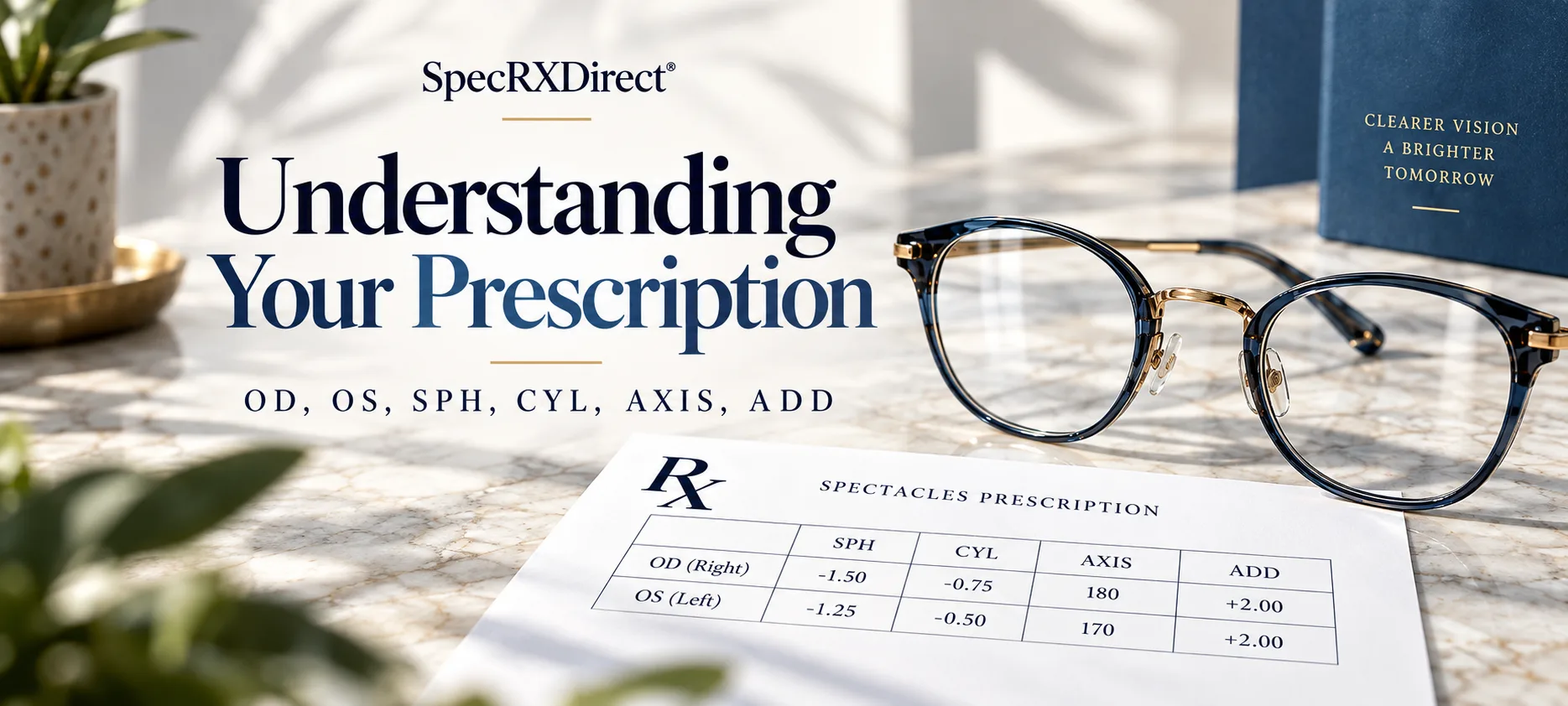
- OD (right eye): SPH -1.50, CYL -0.75, AXIS 180, ADD +2.00
- OS (left eye): SPH -1.25, CYL -0.50, AXIS 170, ADD +2.00
That tells us both eyes are mildly nearsighted, both have a small amount of astigmatism, and both need extra reading power, which points to progressive or bifocal lenses.
What About PD?
Many prescriptions also list PD, or pupillary distance. This is the distance between your pupils in millimeters, and it helps the lab center the lenses properly in your frames. If your prescription does not include it, ask your eye doctor or optical shop for it.
Tips Before You Order New Lenses
- Make sure your prescription is current. Most are valid for one to two years.
- Double check the plus and minus signs. They matter.
- Confirm that every CYL number has a matching AXIS number.
- For progressive lenses, make sure ADD and PD are included.
- If anything looks unclear, ask before you order. A quick question is easier than a remake.
Need Help Reading Your Prescription?
At SpecRXDirect, we replace the lenses in the frames you already love, and our team is happy to help with questions about your prescription before you order. Reach out and we will help you get it right the first time.
This guide is for general education only and is not medical advice. For questions about your eye health or your prescription, speak with your eye care professional.