PD (pupillary distance) is one of the most important measurements for your glasses—but it’s also one of the most confusing. The good news? You can measure it yourself in just a few minutes. What Is PD (Pupillary Distance)? PD is the distance (in millimeters) between the center of your pupils. This measurement ensures your lenses …
PD (pupillary distance) is one of the most important measurements for your glasses—but it’s also one of the most confusing.
The good news? You can measure it yourself in just a few minutes.
What Is PD (Pupillary Distance)?
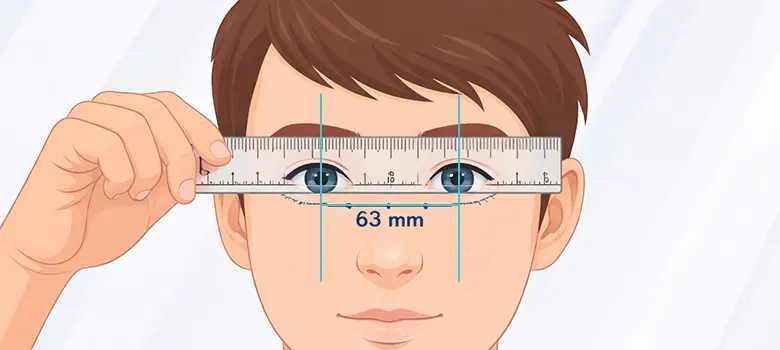
PD is the distance (in millimeters) between the center of your pupils.
This measurement ensures your lenses are aligned correctly with your eyes. If it’s off, even slightly, your vision can feel:
- Blurry
- Strained
- Uncomfortable
How to Measure Your PD at Home
Option 1: Mirror Method (Quick & Easy)
What you need:
- A ruler (millimeter side)
- A mirror
Steps:
- Stand about 8–10 inches from a mirror
- Hold the ruler against your brow
- Close your right eye
- Align the 0 mark with the center of your left pupil
- Open your right eye and close your left
- Read the number at the center of your right pupil
That number = your PD
Option 2: Ask a Friend (More Accurate)
Have someone else measure for you:
- Look straight ahead
- Keep your face relaxed
- They measure from pupil center to pupil center
This usually gives a more precise result.
Option 3: Use Your Old Glasses
If you already have glasses that fit well:
- Some prescriptions or invoices may include PD
- You can also have it measured professionally
Single PD vs Dual PD
You may see:
- Single PD → one number (e.g., 62mm)
- Dual PD → two numbers (e.g., 31/31)
Dual PD is more precise but both are commonly used.
Why PD Matters More Than You Think
Even if your prescription is perfect, incorrect PD can cause:
- Eye strain
- Headaches
- Distorted vision
This is why accurate measurement is critical—especially when ordering lenses online.
What to Do After Measuring Your PD
Once you have your PD, you’re ready to move forward.
👉 The next step is understanding your options and pricing:
How Much Does It Cost to Replace Prescription Lenses?
Tips for a More Accurate Measurement
- Measure more than once and use the number you get most often.
- Look straight ahead at a distant object, not at the ruler.
- Keep your head level and your face relaxed.
- Use a millimeter ruler and keep it steady against your brow.
What Is a Normal PD?
Adult PD values are commonly in the range of about 54 to 74 millimeters, with many people falling somewhere in the low 60s. If your measurement lands far outside that range, measure again. Children have smaller PDs, and near and distance PD can differ slightly.
When PD Matters Most
PD matters for every pair, but it matters most for progressive lenses, strong prescriptions, and anything with a high amount of correction. If you are choosing between lens types, see what are progressive lenses. To understand the rest of your prescription, read understanding your eyeglass prescription, and for ordering, visit our lens replacement page.
Entering Your PD When You Order
Most order forms ask for either a single PD or two numbers, one for each eye. Enter exactly what you measured and double check the digits. If you only have a single PD and the form wants two, ask the provider how to handle it. Progressive lenses may also need a fitting height, which is measured with the frames on your face.
When to Ask a Professional
If your prescription is strong, you wear progressives, or your two measurements keep disagreeing, it is worth having an optician measure your PD. A professional reading is usually quick and removes the guesswork.
Frequently Asked Questions
Is my PD on my prescription?
Sometimes. Many prescriptions do not list it. If yours does not, ask your eye doctor or measure it yourself.
What is the difference between single PD and dual PD?
Single PD is one number for both eyes. Dual PD gives two numbers, one for each eye, and is slightly more precise.
Can I measure my own PD accurately?
Yes, with a ruler and a mirror, or with help from a friend. Measuring more than once improves accuracy.
Conclusion
Yes—you can measure your PD at home.
It’s quick, simple, and makes a big difference in how your glasses feel and perform.