What are progressive lenses? Progressive lenses are multifocal lenses that allow you to see clearly at distance, intermediate, and near ranges (all in one lens) without visible lines. Unlike bifocals or trifocals, progressive lenses blend multiple prescriptions smoothly from top to bottom. That means: No harsh lines. No switching glasses. Just one pair that does …
What are progressive lenses?
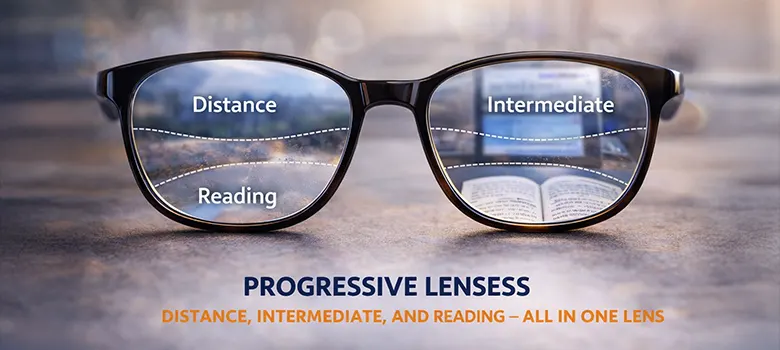
Progressive lenses are multifocal lenses that allow you to see clearly at distance, intermediate, and near ranges (all in one lens) without visible lines.
Unlike bifocals or trifocals, progressive lenses blend multiple prescriptions smoothly from top to bottom. That means:
- The top portion is for distance (driving, watching TV)
- The middle portion is for intermediate vision (computer work)
- The bottom portion is for reading
No harsh lines. No switching glasses.
Just one pair that does it all.
Why Would Someone Need Progressive Lenses?
Most people need progressive lenses because of presbyopia.
Presbyopia is the natural aging process where your eye’s lens becomes less flexible. It usually starts around age 40–45.
If you’ve ever said:
- “My arms aren’t long enough to read this.”
- “I need more light to see small print.”
- “I can see far away fine, but reading is hard.”
You may need progressive lenses.
It’s not a defect. It’s normal aging.
Benefits of Progressive Lenses
Here’s why many people prefer them:
1. One Pair of Glasses
No more switching between reading glasses and distance glasses.
2. No Visible Lines
Bifocals have a line. Progressives don’t.
They look just like regular lenses.
3. Natural Vision Flow
Instead of a sudden “jump” between prescriptions, progressives transition gradually.
4. Better Aesthetics
They look cleaner and more modern.
Are Progressive Lenses Hard to Adjust To?
Sometimes, yes.
The most common complaints:
- Slight distortion on the sides
- Feeling like the floor “moves” when walking
- Needing to tilt your head slightly to find the sweet spot
This adjustment usually lasts a few days to a couple of weeks.
Higher-quality progressive designs reduce distortion significantly.
Cheap, mass-produced lenses tend to cause more discomfort.
Quality matters.
Progressive Lenses vs. Bifocals
| Feature | Progressive Lenses | Bifocals |
|---|---|---|
| Visible Line | No | Yes |
| Intermediate Vision | Yes | No |
| Natural Transition | Yes | No |
| Modern Appearance | Yes | No |
For computer users especially, progressive lenses are usually the better choice.
Can You Put Progressive Lenses in Existing Frames?
Yes.
If your frames are in good condition, you do not need to buy new glasses.
At SpecRXDirect, we replace just the lenses (including progressive lenses) so you can keep the frames you love.
That means:
- Save money
- Keep your style
- Upgrade your vision
When Progressive Lenses May Not Be Ideal
Progressives may not be ideal if:
- Your prescription is extremely high and your frame is too small
- You need occupational-specific lenses
- The frame doesn’t have enough vertical depth
Frame selection matters. Lens design matters even more.
Tips for Getting Used to Progressive Lenses
- Wear them all day, every day, for the first couple of weeks.
- Point your nose at what you want to see, instead of only moving your eyes.
- Lower your chin slightly to read, and raise it a little for the computer.
- Take stairs slowly at first.
What Your Prescription Needs for Progressives
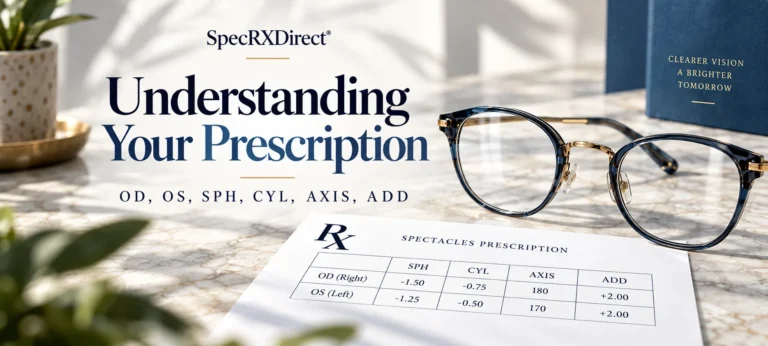
Progressives need an ADD value on your prescription and accurate measurements such as your PD. If yours is missing either, see understanding your eyeglass prescription and how to measure your PD.
Cost and Next Steps
Progressives usually cost more than single vision because they are more complex to make. Our guide on how much it costs to replace prescription lenses explains why. If you are not sure about adjusting, read why new glasses make you dizzy. Ready to start? See our lens replacement page.
Frequently Asked Questions
What are progressive lenses?
Progressive lenses are multifocal lenses that give clear vision at far, intermediate, and near distances in one pair, with no visible lines.
How long does it take to get used to progressive lenses?
Most people adjust within a few days to a couple of weeks.
Can I put progressive lenses in my existing frames?
Often, yes, if the frames are in good condition and have enough vertical depth for the lens design.
Conclusion
If you’re asking what are progressive lenses, you’re likely experiencing normal age-related vision changes.
Progressive lenses offer:
- Seamless vision correction
- One pair instead of two
- Cleaner appearance
- Long-term convenience
And if your current lenses are outdated, scratched, or peeling, you don’t need new glasses.
You just need new lenses.
Ready to upgrade your vision without replacing your frames?
Explore our lens replacement options today.